Health Insurance for Domestic Workers in UAE: Cost, Rules & How to Get Covered by Emirate (2026)
Your worker’s visa renewal just got rejected or you’re bracing for it because of one line item you weren’t sure how to handle: health insurance for domestic workers in UAE. You’re not alone in finding this confusing. Search around for a straight answer on cost and you’ll run into three or four different numbers: AED 320, AED 550, AED 635, AED 750. None of them are wrong. They’re just answers to different questions, because the UAE doesn’t run one health insurance scheme, it runs three, one per emirate group, each with its own price and its own rules.
Add to that the constant mix-up between health insurance, ILOE, and wage-protection insurance, three completely different products people talk about as if they’re the same thing and it’s no surprise sponsors end up either overpaying, under-covering their worker, or missing a renewal deadline entirely.
This guide sorts out exactly which scheme applies to you, what it actually costs, and what happens if you skip it.
Quick answer
Yes, health insurance for domestic workers is mandatory across all seven emirates as of January 1, 2025. The employer (sponsor) pays for it, never the worker. The cost and the specific scheme depend on which emirate the worker is based in, ranging from about AED 320/year in the Northern Emirates to AED 750/year in Abu Dhabi.
What Changed: The UAE’s Mandatory Health Insurance Rollout
Dubai and Abu Dhabi have required employer-provided health insurance for years. Dubai’s mandate goes back to 2013, Abu Dhabi’s even earlier. What’s newer is the rest of the country catching up.
As of January 1, 2025, the Cabinet extended mandatory health insurance to private-sector employees and domestic workers in Sharjah, Ajman, Ras Al Khaimah, Umm Al Quwain, and Fujairah, the five emirates that previously had no unified requirement. MOHRE built this out with the Federal Authority for Identity, Citizenship, Customs, and Port Security and the Ministry of Health and Prevention, introducing a new Basic Health Insurance package specifically for this group.
The practical effect: there’s no longer any emirate in the UAE where you can sponsor a domestic worker without insuring them. And it’s not a paperwork formality; a valid policy is now checked automatically at every visa issuance and renewal, the same way your worker’s labour card status gets checked against WPS. Let it lapse, and your worker’s visa renewal simply won’t go through.

Is Health Insurance Really Mandatory for Domestic Workers in UAE?
Yes and this isn’t new enough to still be in doubt, but it’s still one of the most-asked questions on the topic, so it’s worth stating plainly: there’s no opt-out.
Two things matter here that people often get backwards:
It’s the employer’s obligation, not the worker’s. MOHRE has explicitly reminded companies and sponsors that workers must never be asked to cover any part of the cost of obtaining or renewing their health insurance. Under Dubai Law No. 11 of 2013, deducting the premium from a domestic worker’s salary is prohibited outright, and the same principle holds across the other emirates.
It’s tied directly to the visa system, not just “the law” in the abstract. This is the part that actually enforces compliance with GDRFA and the relevant emirate authority checks for an active policy at the point of visa stamping. No valid insurance means no renewal, full stop.
Domestic Helper Health Insurance Cost by Emirate
This is where most of the confusion comes from. There isn’t one national price, there are three separate schemes, and the numbers you’ve seen floating around probably belong to different ones.
| Emirate(s) | Scheme | Approx. Annual Cost | Coverage Limit | Administered By |
|---|---|---|---|---|
| Dubai | DHA Essential Benefits Plan (EBP) | AED 550–650 (some insurers from ~AED 635) | AED 150,000 | DHA-approved insurers |
| Abu Dhabi | Basic Health Insurance Plan | AED 750 (under-60, sponsored by a UAE national) | AED 250,000 | Daman (National Health Insurance Company) |
| Northern Emirates (Sharjah, Ajman, RAK, UAQ, Fujairah) | Basic Health Insurance package | AED 320 | AED 50,000 | MOHRE, in coordination with approved insurers |
A few things worth understanding about these numbers rather than just memorizing them:
Dubai’s EBP and the “AED 320” figure aren’t the same product. If you’ve seen both prices and assumed one was outdated, that’s the mix-up AED 320 belongs to the Northern Emirates scheme, not Dubai. Dubai’s EBP is a DHA-regulated plan specifically for residents (including domestic workers) earning AED 4,000 or less per month, with a materially higher coverage ceiling.
Abu Dhabi’s plan has eligibility bands based on housing. The AED 750/year premium applies to domestic workers under 60 sponsored by a UAE national, earning AED 5,000 or less per month without employer-provided housing, or AED 4,000 or less with housing included. If you’re sponsoring as an expat resident rather than a UAE national, confirm your exact premium with Daman directly pricing tiers can differ by sponsor category.
The Northern Emirates scheme is genuinely the cheapest and newest. At AED 320/year, it’s a two-year valid policy covering ages 1–64, open to private-sector employees and domestic workers across Sharjah, Ajman, RAK, UAQ, and Fujairah without the salary-band restrictions Dubai and Abu Dhabi apply. It also covers chronic illnesses and pre-existing conditions without a waiting period, something the pricier plans often don’t offer at the basic tier.
If your worker’s residency is in a different emirate than where you’re registered as a sponsor, don’t assume one policy covers both compliance is based on the worker’s residency emirate, and each scheme only operates within its region (Abu Dhabi’s Basic Plan, for instance, covers emergencies elsewhere in the UAE but treatment is expected within Abu Dhabi’s own network).
ILOE vs. Health Insurance vs. Workers Protection Insurance Don’t Confuse These Three
If you’ve spent any time reading about UAE labour insurance, you’ve probably seen these three terms used almost interchangeably online. They’re not the same thing. Mixing them up leads to real confusion that comes up constantly in forums, where people argue about whether domestic workers are “exempt” from something without specifying which scheme they mean.
Health Insurance For Domestic Workers in UAE
What this article is about. Covers medical costs: doctor visits, hospitalization, medication, maternity care. Mandatory for domestic workers, cost varies by emirate as above.
ILOE (Involuntary Loss of Employment Insurance)
A completely separate scheme under Federal Decree-Law No. 13 of 2022. It pays 60% of an employee’s basic salary for up to three months if they’re made redundant through no fault of their own.
Here’s the point that causes most of the confusion: domestic workers are exempt from ILOE. They’re not required to subscribe, and they don’t pay the AED 5–10/month premium other private-sector employees pay. This is explicitly listed among MOHRE’s ILOE exemptions, alongside investors, business owners, and workers under 18.
Workers Protection Insurance
Sometimes called “Insurance on Domestic Worker Contracts” a third, distinct product that protects against unpaid wages, covering amounts up to AED 20,000 if an employer fails to pay. This is about wage security, not health coverage or unemployment. A different risk being insured against entirely.
Keeping these three separate matters practically: an insurance renewal reminder about ILOE doesn’t apply to your domestic worker, and confirming health insurance compliance doesn’t automatically mean the wage-protection product is also in place if they’re bought and renewed independently.
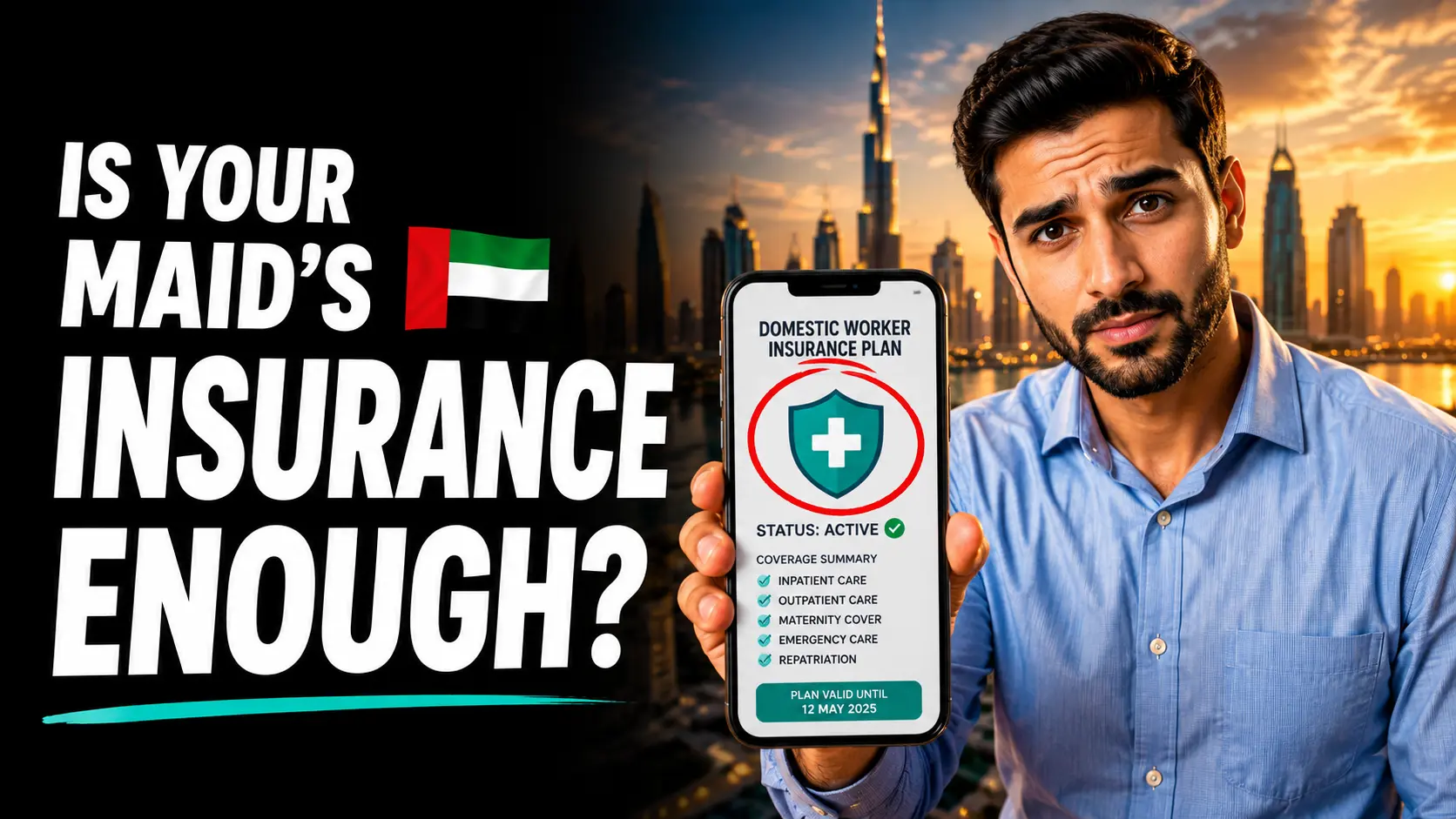
What the Coverage Actually Includes (and What to Check Before Buying Health Insurance)
Not all “basic” plans behave the same way in practice, and the gaps tend to show up exactly when you need coverage most. A few specifics worth checking before you buy, rather than after a claim gets rejected:
Outpatient vs. inpatient-only coverage. Some cheaper policies only cover hospitalization (inpatient) and leave routine doctor visits (outpatient) uncovered, or covered only at clinics rather than hospitals. Confirming which one your plan actually includes this is one of the most common reasons people end up paying out of pocket for something they assumed was covered.
Maternity waiting periods. Maternity coverage is standard on plans like the EBP, but it typically kicks in only after a waiting period commonly around six months from the policy start date. If this applies to your worker, timing matters.
Pre-existing condition disclosure. This is worth taking seriously: if a worker has an existing condition (diabetes, hypertension, a fibroid that may need future surgery), it needs to be disclosed at the time the policy is taken out. Insurers can and do reject claims later on the grounds that a condition wasn’t declared upfront, even once the waiting period has passed.
Network hospitals. Check that at least a few reputable hospitals or clinics near where your worker actually lives are included in the plan’s network; a technically valid policy isn’t much use if the nearest covered facility is an hour away.
Dental and optical. Generally excluded from basic and EBP-tier plans unless you pay for an add-on. If this matters, it needs to be arranged separately.
Why this level of caution matters: UAE-based doctors who treat uninsured or under-insured patients regularly point to cases like emergency abdominal surgery or a complicated pregnancy running well over AED 20,000 in hospital costs alone the exact kind of bill basic coverage exists to absorb, but only if the plan you bought actually includes the right type of cover for it.
How to Get Health Insurance for Your Domestic Worker in UAE ?
There are three common routes, and which one makes sense depends on how you sponsor the worker in the first place:
- Directly through an approved insurer. You select a DHA, DoH, or MOHRE-approved provider offering the relevant emirate’s scheme (EBP, Abu Dhabi Basic, or the Northern Emirates package) and purchase the policy directly, usually online or through an agent.
- Through your emirate’s digital government platform. Abu Dhabi, for example, now processes Basic Plan renewals for domestic workers through TAMM, Abu Dhabi’s unified government services platform; the renewal itself can be completed in about 15 minutes without submitting fresh documents.
- Bundled through a recruitment or sponsorship agency. If you’re hiring through an agency-style arrangement, health insurance is often baked into the overall fee. This is convenient, but it’s worth confirming exactly which plan tier is included. “insurance is covered” doesn’t tell you whether it’s a basic EBP-level plan or something more comprehensive.
Whichever route you use, insurance has to be active and verifiable before the visa or work permit is issued or renewed. Leave it until the last minute and you risk a delay on the visa side, not just the insurance side. Health insurance is just one piece of your broader obligations as a sponsor; for the full picture of what’s legally required from working hours to salary rules see our complete guide to UAE domestic worker labour law.
What Happens If You Don’t Have Health Insurance in the UAE ?
Skipping health insurance for a domestic worker in the UAE doesn’t just risk a fine, it stops the visa process outright.
Visa renewal is blocked automatically. Since coverage verification now happens at the point of visa issuance and renewal, an inactive or missing policy means the renewal simply won’t process, regardless of how prompt everything else is.
Fines apply for non-compliance, and enforcement has been tightening.
One clarification worth making: a widely-searched “AED 400 fine” figure people associate with this topic actually comes from a different scheme, the ILOE non-registration penalty for eligible employees. Since domestic workers are exempt from ILOE entirely, that specific fine doesn’t apply to them.
The risk that actually matters for health insurance is simpler and bigger: without active coverage, your worker’s visa cannot be renewed at all. That’s a far more disruptive problem than any fixed fine, since it stalls their legal residency status until it’s resolved.
Frequently Asked Questions
Is ILOE still mandatory?
Yes, for most private-sector employees but domestic workers are specifically exempt. If you’re sponsoring a domestic worker, you don’t need to subscribe to ILOE; it’s a separate scheme covering job-loss compensation for other categories of workers.
What is DHA Basic insurance?
“DHA Basic” typically refers to the Essential Benefits Plan (EBP) Dubai’s minimum mandatory health insurance tier for residents, including domestic workers, earning AED 4,000 or less per month. It carries an annual coverage limit of AED 150,000.
Can I claim ILOE if I resign?
No ILOE only pays out for involuntary job loss, not resignation or termination for misconduct. This question doesn’t apply to domestic workers directly, since they’re outside the scheme entirely, but it’s a common point of confusion for sponsors managing insurance for other household or business staff too.
How much does a doctor visit cost without insurance in the UAE?
It varies by clinic and treatment type, but outpatient visits without insurance commonly run from a few hundred dirhams for a basic consultation up into the thousands for anything requiring diagnostics or a specialist, which is exactly the cost exposure basic health insurance is designed to prevent.
What is the AED 400 fine about?
This figure is commonly searched in connection with UAE labour insurance, but it actually refers to the ILOE non-registration fine for eligible employees, not a health insurance penalty. Since domestic workers are exempt from ILOE, this particular fine doesn’t apply to them; the real consequence of missing health insurance is a blocked visa renewal.
Additional Resources
- MOHRE The Basic Health Insurance Scheme (official guidance)
- Dubai Health Authority (DHA) Essential Benefits Plan
- Daman Abu Dhabi Basic Health Insurance Plan
- TAMM Abu Dhabi Basic Plan renewal for domestic workers
Conclusion
Health insurance for domestic workers in UAE isn’t a single national product; it has three separate schemes, one per emirate group, each with its own price and its own rules. Get the right one for where your worker is based, keep it active through every renewal, and you avoid the two things that actually cause problems: a blocked visa and a rejected claim.
If you take one thing away from this guide, make it this: confirm which scheme applies to your worker’s emirate, check that the coverage type (outpatient vs. inpatient, maternity, pre-existing conditions) actually matches their real needs, and never let the policy lapse before a renewal is due. That’s the difference between insurance that’s just technically compliant and insurance that actually protects your worker and your visa status when it matters.