How to Hire a Domestic Worker in UAE: Legal Process, Cost & Requirements (2026)
Trying to work out how to hire a domestic worker in UAE and getting three different answers from three different people? You’re not imagining it. Someone tells you AED 8,500 for two years, someone else says AED 17,000, a Reddit thread mentions AED 14,000 and none of them explain why. On top of that, Dubai Police keep warning residents to only use licensed agencies, which raises the obvious follow-up question: what actually counts as “licensed,” and what happens if you get this wrong?
The confusion isn’t your fault. There are genuinely two different legal ways to hire, each with its own cost structure, eligibility rules, and paperwork and almost nothing online lays them out side by side.
This guide does exactly that: the two legal hiring paths, whether you actually qualify to sponsor privately, what it really costs, and the step-by-step process to do it right.
Quick answer
There are two legal ways to hire a domestic worker in the UAE: private sponsorship (you become the legal sponsor directly) or company/Tadbeer sponsorship (a MOHRE-licensed provider remains the legal employer). Private sponsorship requires a minimum household income of AED 25,000/month and a two-bedroom home; Tadbeer sponsorship has a lower income bar and handles most of the paperwork for you. Either way, hiring outside a MOHRE-licensed channel is illegal and carries real fines.
Recruitment vs. Sponsorship: The Distinction Almost Everyone Misses
Before anything else, it’s worth untangling two words people use interchangeably because mixing them up is where most of the confusion in this whole process starts.
Recruitment is how a domestic helper is sourced and placed finding the person.
Sponsorship is who is legally responsible for their visa, contract, salary compliance, and regulatory obligations a completely different question.
You can find someone through a Tadbeer centre, an agency, or a personal referral, and still end up being the one legally responsible for everything that follows. Or you can go through a company-sponsorship arrangement where the agency stays the legal employer even after the worker is placed in your home. Same worker, same household, two very different legal setups which is exactly why the next section matters.

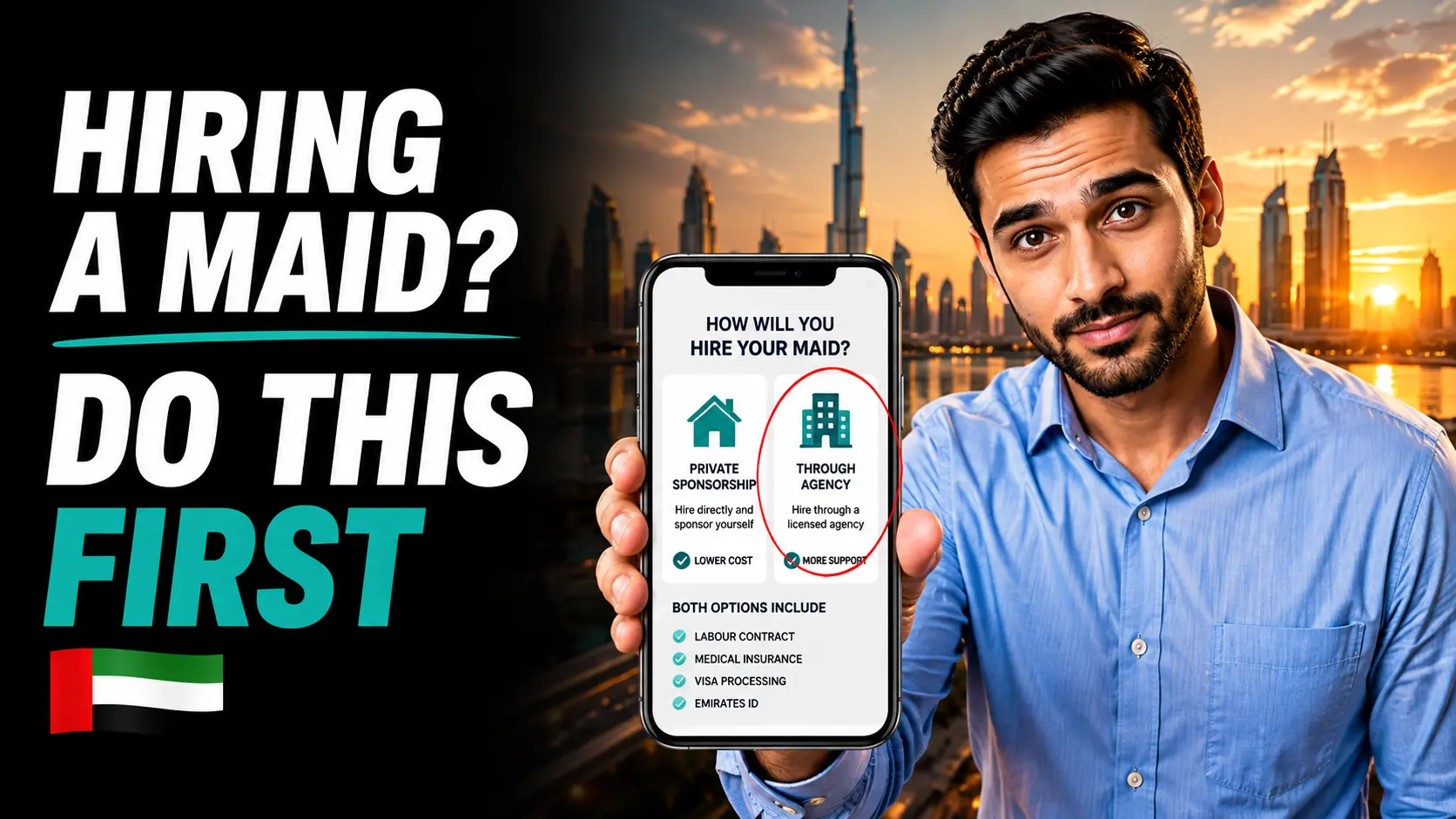
Two Legal Ways to Hire a Domestic Helper: Private vs. Company Sponsorship
| Private Sponsorship | Company (Tadbeer) Sponsorship | |
|---|---|---|
| Legal sponsor | You (the household) | The licensed provider/agency |
| Your ongoing obligations | Visa, contract, wages, leave, insurance, end-of-service — all on you | Reduced admin — provider handles most compliance |
| Income requirement | AED 25,000/month (expat), AED 10,000/month (UAE nationals) | Often lower, sometimes no fixed household-income bar |
| Typical cost | Visa/processing fees separate from salary | Often bundled — one quoted price covering visa, medical, insurance |
| Best for | Households that clearly meet the income/accommodation bar and want direct control | Households below the income threshold, or who want less paperwork |
Under private sponsorship, the household becomes the legal sponsor responsible for visa processing, the employment contract, WPS-compliant wage payments, leave, mandatory health insurance, and end-of-service obligations. That’s the full weight of compliance sitting on you.
Under company sponsorship, a MOHRE-licensed provider (Tadbeer-style centre, or a regulated company like maids.cc) remains the legal employer while the worker is assigned to your household under a regulated arrangement.
This reduces your paperwork and legal exposure significantly. It’s part of why many families choose this route even when they could technically qualify for private sponsorship not just households below the income threshold, but anyone who’d rather have the administrative burden handled for them.
Do You Qualify to Sponsor a Domestic Worker Privately?
This is the gate most people don’t find out about until they’re already partway through the process worth checking first.
Minimum income. For private sponsorship as an expatriate resident, MOHRE and the relevant immigration authority (GDRFA/ICP depending on your emirate) require a minimum monthly income of AED 25,000. This can be combined household income and both spouses’ salaries count together, so it doesn’t need to come from one earner. UAE nationals qualify at a lower threshold, generally AED 10,000/month.
Accommodation. You need to be residing in a property with a minimum of two bedrooms. A studio or one-bedroom flat doesn’t meet the requirement. The extra room needs to genuinely function as private sleeping space for the worker, not just a spare corner.
Residency status. You must hold a valid UAE residence visa (or be a UAE national) visit visa holders cannot sponsor a domestic worker under any circumstances.
If you’re hiring a driver specifically, there’s an additional requirement: you need two vehicles registered in your name, one for yourself, one for the driver to operate. This is a genuinely under-explained rule that catches people off guard when they assume driver-hiring works the same as hiring a housekeeper or nanny.
If you don’t meet the income threshold, you’re not out of options. This is exactly the scenario company/Tadbeer sponsorship exists for, since its income bar sits lower (often around AED 10,000/month) and the provider absorbs the sponsor role instead of you.
How Much Does It Actually Cost to Hire a Domestic Worker?
There’s no single number here, and that’s not sites contradicting each other, it’s genuinely different scenarios producing different totals. Breaking it down properly:
One-time costs (private sponsorship route): Whether you process this yourself through a typing centre or GDRFA directly, or use a Tadbeer centre to help with paperwork under your own private sponsorship, total government and processing fees typically run around AED 17,000, plus a refundable deposit of roughly AED 2,000. This covers the entry permit, medical fitness test, Emirates ID registration, and visa stamping. Note that “private sponsorship” refers to you being the legal sponsor; it doesn’t necessarily mean doing every step yourself without any centre’s help.
One-time costs (Tadbeer/company sponsorship route): Here the provider itself becomes the legal sponsor, not you. Packages are usually quoted as a single all-inclusive price, commonly falling somewhere between AED 8,500 and AED 17,000, depending on the provider, the worker’s nationality, and whether insurance and medical testing are bundled in.
These different figures aren’t sites contradicting each other; an AED 8,500 two-year package and an AED 17,000 quote usually reflect different providers, different bundled inclusions, or different sponsorship routes entirely (who ends up as the legal sponsor matters more to the price than it might seem).
Transferring a worker already in the UAE (moving someone from one sponsor to another) is typically cheaper than a fresh overseas hire, commonly AED 6,000–10,000 through a Tadbeer centre, covering visa cancellation, new visa issuance, medical test, and insurance.
Ongoing monthly costs, regardless of which path you choose: the worker’s salary, mandatory health insurance, and accommodation and food. There’s no government-mandated minimum wage specifically for domestic workers, so pay is whatever’s agreed in the signed contract but market rates commonly range AED 1,500–3,500/month depending on the role, the worker’s experience, and nationality. Many contracts also include an annual home flight ticket as a standard benefit, though this is a matter of contract terms and common practice rather than a fixed line in the law itself confirming what’s included before signing.
One nationality-related myth worth clearing up directly: the widely-referenced “Filipino and Indonesian maid ban” is outdated information still circulating online. That restriction existed from 2014 and was lifted through a formal UAE-Philippines labour agreement, with deployment officially resuming from March 31, 2021, under a new Unified Employment Contract framework designed to strengthen worker protections. As of 2026, both the Philippines and Indonesia are fully approved source countries for domestic worker recruitment through licensed channels. If you’ve seen older content suggesting otherwise, it’s referencing a restriction that no longer applies.
Step-by-Step: How to Hire a Domestic Worker in UAE
- Decide your path. Private sponsorship if you meet the income/accommodation bar and want direct control, or Tadbeer/company sponsorship if you’re below the threshold or want less admin.
- Confirm eligibility if going private. Check your combined household income against the AED 25,000 threshold and confirm your accommodation qualifies before you start.
- Source candidates through a MOHRE-licensed centre only. Not informal social media listings, not word-of-mouth arrangements outside a licensed channel. You can find approved Domestic Worker Service Centres through MOHRE’s official centre locator, or by confirming a specific provider’s license status directly with MOHRE before engaging them; this is the single most important step for staying legal and avoiding the scam risks covered below.
- Prepare your documents. Typically your passport and residence visa copy, Emirates ID, Ejari or registered tenancy contract, and a salary certificate or equivalent proof of income.
- Formalize the contract, medical test, and visa issuance. Every domestic worker must be employed under the MOHRE Unified Standard Employment Contract this isn’t optional paperwork, it’s a legal requirement, and employing someone without a registered contract exposes you to fines regardless of how the hire otherwise looks legitimate.
- Register for WPS and mandatory health insurance. Salary must be paid through the Wages Protection System, and insurance needs to be active before the visa can be issued or renewed.
Hiring Someone as a domestic worker in UAE You Already Know (Direct/Private Hire Scenarios)
A common real-world scenario: you’ve found someone through a friend, family referral, or you’re looking to sponsor a worker who’s currently under someone else’s sponsorship (an agency, or another family) and wants to move to you directly.
This is completely legal but it still has to go through the same registration steps as any other hire. It’s not a shortcut around MOHRE contracts, medical testing, or visa processing; it’s a transfer of sponsorship, and it still needs to be formalized through a licensed channel. The previous employer’s release is required before the transfer can proceed, and the process is typically handled through a Tadbeer centre or directly via MOHRE if the worker is already fully documented and simply switching sponsors.
Skipping the formal transfer step for example, having someone start working for you informally while “sorting out the paperwork later” is exactly the kind of arrangement that creates legal exposure for both you and the worker, even when the intent behind it is completely good-faith.

How to Avoid Scams and Illegal Hiring of a domestic worker
This isn’t a minor compliance footnote, it’s a genuine, active concern. Dubai Police have publicly urged residents to hire domestic workers only through licensed agencies to protect households from fraud and protect workers from exploitation, and to deal exclusively with authorized recruitment offices. Reports of fake recruitment offices and unlicensed intermediaries collecting fees for placements that never materialize are common enough that MOHRE itself has issued direct reminders to check licensing, confirm refund/replacement protection, and keep every contract and receipt on file.
Your recruitment agency itself matters here too “domestic worker recruitment agencies uae” only means something if the agency is actually MOHRE-licensed. An unlicensed agency charging recruitment fees for domestic worker placement is operating illegally regardless of how professional its marketing looks.
Practical steps to protect yourself:
- Only use MOHRE-licensed Domestic Worker Service Centres (Tadbeer) or verified companies operating under proper licensing, never an unlicensed “agent” working through WhatsApp or social media with no verifiable registration.
- Verify the centre’s licensing status before paying anything a legitimate provider will have no issue confirming this.
- Never pay unlicensed intermediaries, even if they claim to offer a faster or cheaper route this is precisely the setup Dubai Police have flagged.
- Keep every contract and receipt. If a dispute arises later, documentation is what protects you.
- Report suspicious hiring arrangements you encounter this has become enough of a recognized issue that public awareness campaigns specifically ask residents to flag it.
Hiring outside a licensed pathway isn’t just risky, it’s illegal, and it carries real financial exposure. Illegal hiring arrangements fall under the same penalty framework covered in our full guide to UAE domestic worker labour law, where fines for unlicensed hiring reach into the tens of thousands of dirhams.
Frequently Asked Questions
Can I sponsor my maid in the UAE?
Yes, as long as you meet the eligibility requirements — a minimum monthly income of AED 25,000 as an expat resident (or AED 10,000 for UAE nationals), suitable two-bedroom accommodation, and a valid UAE residence visa. If you don’t meet the income threshold, Tadbeer/company sponsorship is the alternative route.
How much does a maid visa cost in the UAE?
It depends on the route. Private sponsorship visa processing typically runs around AED 17,000 plus a refundable deposit of roughly AED 2,000. Tadbeer/company-sponsored packages commonly range from AED 8,500 to AED 17,000, depending on the provider and what’s bundled into the price.
What are the requirements to hire a maid in Dubai?
A valid UAE residence visa, proof of minimum income (AED 25,000/month for expats under private sponsorship), suitable accommodation with at least two bedrooms, and hiring exclusively through a MOHRE-licensed Domestic Worker Service Centre or authorized provider.
What are the recruitment fees for a domestic worker agency in UAE?
Licensed Tadbeer centres and agencies typically bundle recruitment fees into the overall package price rather than charging a separate line item; this is part of what the AED 8,500–17,000 range covers. Any fee charged by an unlicensed intermediary outside a MOHRE-registered agency isn’t a legitimate recruitment fee at all, regardless of what it’s called.
How do I check my MOHRE domestic worker application status?
Application status can be checked through MOHRE’s official portal or app using your application/transaction reference number, the same way contract and labour card status checks work for other MOHRE services.
How many hours should a domestic worker work in the UAE?
This article covers the hiring process, not day-to-day working conditions — for working hours, rest days, leave, and the full set of worker rights and employer obligations once someone is hired, see our complete guide to UAE domestic worker labour law.
Additional Resources
- MOHRE – Domestic Worker Services
- MOHRE – Approved Domestic Worker Service Centres (Tadbeer)
- GDRFA – Residency and visa services
Conclusion
Hiring a domestic worker in the UAE really comes down to one decision made early and made correctly: private sponsorship if you meet the income and accommodation bar and want direct control, or Tadbeer/company sponsorship if you’re below the threshold or would rather have the paperwork handled for you. Everything else cost, documents, timeline follows from that choice.
The single biggest risk isn’t picking the “wrong” path between those two both are legal, both work. The real risk is stepping outside a MOHRE-licensed channel entirely, whether that’s an unlicensed agent, an informal arrangement “for now,” or skipping the registered contract. That’s what turns an otherwise straightforward hire into a legal and financial problem for both you and the worker. Stay inside a licensed pathway, confirm your eligibility before you start, and the rest of the process is genuinely manageable.