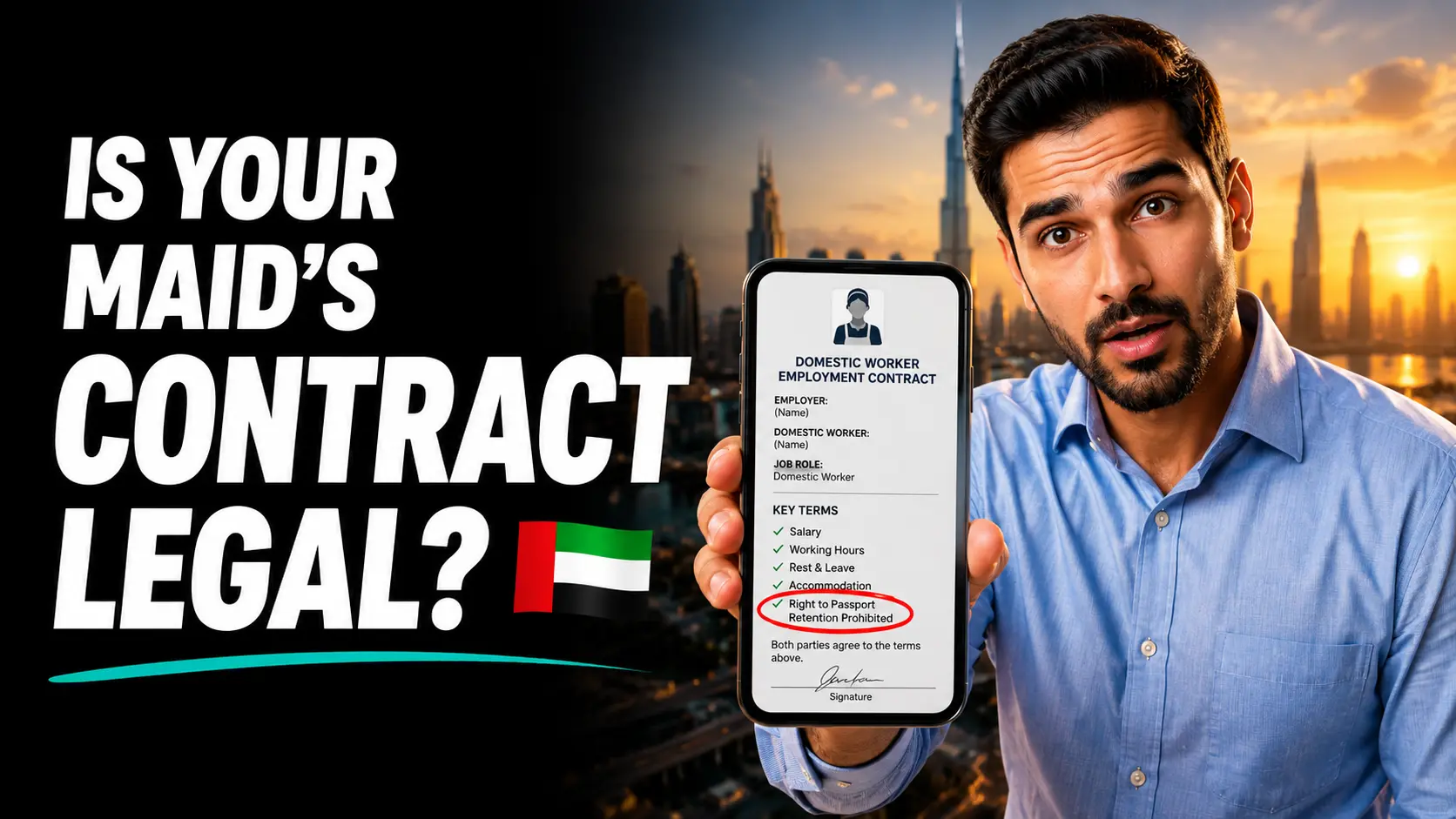
Labour Law For Domestic Workers in UAE: Complete Guide to Rights, Hours & Penalties (2026)
“There’s no gratuity, it’s discretionary.” “Just keep the passport safe so she doesn’t run away.” “She’s basically on-call all day, she lives here anyway.” “Pay her cash, it’s simpler for everyone.”
If any of that sounds familiar from a Reddit thread, a WhatsApp group, or an agency that “assured” you it’s normal none of it is actually correct under the law. And if you’re the domestic worker on the other side of one of these situations, wondering whether what’s happening to you is even legal, you’re not alone either. It’s one of the most-asked questions in every UAE expat forum, and most of the confident answers people give are wrong, outdated, or just repeating what “everyone does.”
This guide sets the record straight, using the actual labour law for domestic workers in UAE as it stands today, not the 2017 rules half the internet is still quoting, and not agency folklore.
Quick Answer
Domestic workers in the UAE (maids, nannies, drivers, and 16 other roles) are governed by Federal Decree-Law No. 9 of 2022, amended by No. 21 of 2023 a separate law from the one covering regular private-sector jobs. It sets a 12-hour daily work cap, a weekly paid day off, 30 days of annual and sick leave, and bans employers from holding a worker’s passport. Illegal hiring carries fines of AED 50,000–200,000.
What Is Federal Decree-Law No. 9 of 2022 in the UAE?
Before December 2022, domestic workers in the UAE were governed by Federal Law No. 10 of 2017. That law has been replaced.
Federal Decree-Law No. 9 of 2022 Concerning Domestic Workers is the current legislation. It was amended the following year by Federal Decree-Law No. 21 of 2023, which adjusted several provisions, including how disputes are referred to MOHRE.
The day-to-day detail fines, contract templates, recruitment agency rules sits in Cabinet Resolution No. 106 of 2022, which is the executive regulation issued to implement the law. When people search for “the new domestic worker law,” this is the trio they usually mean.
One thing worth clearing up early: this law is separate from Federal Decree-Law No. 33 of 2021, the standard UAE Labour Law that covers private-sector employees. Article 3 of that law specifically excludes domestic workers from its scope. That’s why a housemaid’s gratuity, notice period, and working hours don’t work the same way as office employees; they’re calculated under a different legal framework entirely.
Who Counts as a Domestic Worker in the UAE?
The law defines 19 occupations as domestic work. If your household staff member’s role appears on this list, this is the law that applies to them, not the general Labour Law.
Housemaid
Sailor
Guard
Shepherd
Jockey
Animal tamer
Falcon caretaker
General worker
Housekeeper
Cook
Nanny / babysitter
Farm worker / grower
Gardener
Personal trainer / coach
Private tutor
Home nurse
Personal assistant
Private agricultural engineer
Personal or family driver
A quick practical note: the law also prohibits discrimination against workers in any of these roles based on race, colour, gender, religion, or nationality and bans hiring anyone under 18, in any of the 19 categories.

Working Hours & Rest Periods For a Domestic Worker
This is one of the most searched questions about domestic work in the UAE, and the answer is different from a standard office job.
Domestic workers are entitled to at least 12 hours of rest per day, of which at least 8 hours must be consecutive. In practice, that caps the working day at roughly 12 hours. On top of the daily rest, they get one full paid day off per week.
If an employer needs the worker to work on their rest day, the law requires either an alternative day off in lieu, or cash compensation for that day, not just an unpaid ask.
Twelve hours of guaranteed rest with 8 of them uninterrupted is a real, enforceable minimum, not a courtesy. Treating a live-in worker as available around the clock, with no defined rest window, isn’t just poor practice, it’s a violation of the law as written.
Salary, WPS & Payment Rules in the UAE
Wages must be paid as agreed in the worker’s contract, and the law requires payment within 10 days of the due date; there’s no grace period built in beyond that.
The bigger shift in recent years is how that payment has to happen. Domestic worker wages now fall under the Wages Protection System (WPS), the same electronic salary-transfer system used across the private sector. Paying strictly in cash, with no digital record, creates a real problem if a dispute ever comes up MOHRE and the courts rely on WPS records as proof of payment, and a household with no paper trail has nothing to point to.
If you want the fuller picture on how WPS payments are checked and verified, our Labour Card guide walks through the related MOHRE verification steps.
One more thing worth knowing: the law doesn’t set a minimum salary for domestic workers. The wage is whatever’s agreed and written into the contract which is exactly why getting the contract terms right at the start matters more than it would in a job with a legal wage floor.
Annual Leave & Sick Leave
Once a domestic worker completes one year of continuous service, they’re entitled to 30 days of paid annual leave, paid in full before the leave is taken. If someone leaves the job between 6 months and a year of service, they’re entitled to a pro-rated 2 days of leave for every month worked, rather than nothing.
Sick leave is 30 days a year, but it isn’t paid the same way for all 30. The first 15 days are fully paid, and the next 15 days are paid at half rate. That’s a detail worth knowing before assuming a full month of sick leave means full pay throughout it doesn’t.
End-of-Service Gratuity for Domestic Workers
This section needs a more careful answer than most sites give it, so it’s worth slowing down here.
Federal Decree-Law No. 9 of 2022 does not, in its own text, set out a gratuity formula. Article 22 of the law leaves the calculation and payment of end-of-service gratuity to future regulations to be issued by the Cabinet; it doesn’t specify a number of days per year of service.
The 14 days of basic wage per year figure that you’ll see on almost every gratuity calculator online including some of MOHRE’s own guidance pages comes from the earlier, now-repealed Federal Law No. 10 of 2017. That older law did include a specific gratuity formula. The current law replaced it but didn’t carry the formula over in its own text, and the Cabinet regulation specifically covering gratuity calculation hasn’t been issued as separate, standalone rules the way it has for other parts of the law.
In practice, most employers, agencies, and even some MOHRE typists still apply the old 14-days-per-year figure as the working standard, since there’s nothing else in circulation to use instead.
If you’re budgeting for it, that’s a reasonable number to plan around. But it’s worth knowing it’s a carried-over convention, not a figure written into the current law. If a contract or agency states it differently, don’t assume the 14-day number automatically overrides what’s in your paperwork when in doubt, MOHRE’s helpline or a labour consultant can confirm the current position for your specific case.
For a general breakdown of how end-of-service pay works for private-sector employees (a different formula, 21/30 days depending on service length), see our final settlement calculation guide. Some employers also use the Cabinet’s alternative end-of-service savings scheme instead of a lump-sum gratuity worth a look if you’re comparing options.
Passport & Personal Documents
This comes up constantly in online forums, and the law is unambiguous: a domestic worker’s passport belongs to them.
Employers cannot hold a domestic worker’s passport, Emirates ID, or other personal identification documents. The old habit of “keeping the passport safe” to prevent a worker from leaving isn’t a grey area; it’s a direct violation of the law, regardless of intent.
If a passport is currently being held, the worker can report it directly to MOHRE, including through their online complaint channels.
Employer Obligations
Beyond wages and hours, the law sets out a fuller list of what an employer has to provide:
- A written contract using MOHRE’s approved template, with a copy given to the worker
- Appropriate accommodation and food
- Medical care or health insurance, at the employer’s expense
- A round-trip ticket home every two years
- Respectful treatment and a safe working environment
- Compensation for any work-related injury or occupational illness
- No assigning tasks outside the agreed role without the worker’s consent
It’s worth pausing on the cost side here: the total cost of employing a domestic worker is more than just the monthly salary. Accommodation, food, insurance, and the biennial flight home are all legal obligations, not optional extras and skipping them isn’t a shortcut, it’s a compliance gap.
Domestic Worker Obligations
The law is not one-sided workers have obligations too, and it helps both parties to know them clearly:
- Carry out the agreed work personally, under the employer’s reasonable direction
- Avoid unexplained absence from work
- Respect UAE customs, traditions, and public morals
- Follow lawful instructions that don’t contradict the contract or expose them to risk
- Take reasonable care of the employer’s property and tools
- Keep confidential information learned through the job private, even after employment ends
- Assist in emergencies that threaten the household
Can a Domestic Worker Resign or Break a Contract?
Yes a domestic worker can resign, but what happens next depends on how and when they do it.
It also depends on timing. Contracts typically include a probation period of up to 6 months from the start date. Leaving during probation, or shortly after it ends, is generally treated differently from leaving several years into a long-standing role; the notice terms in the specific contract matter here more than a single blanket rule.
If a worker resigns in line with their contract terms (typically after giving the notice period specified in the agreement), the resignation is straightforward and shouldn’t affect entitlements they’ve already earned, like unpaid wages for time worked.
Breaking a contract early leaving before the agreed term without valid cause or proper notice is a different situation. It can affect matters like gratuity eligibility, and depending on the circumstances, may involve the employer or agency raising a complaint with MOHRE. If there’s a genuine issue driving the resignation (unpaid wages, unsafe conditions, contract violations), that’s grounds MOHRE will consider differently than someone leaving without cause.
If you’re trying to verify what your specific contract says about notice periods and termination terms, our MOHRE labour contract check guide shows how to look up the registered contract online.
Illegal Hiring & Penalties
This is where a lot of well-meaning households get caught out, often without realising it.
Hiring a domestic worker without a valid MOHRE-issued work permit through informal social media arrangements, unlicensed “agents,” or a worker who came on someone else’s sponsorship is treated as illegal hiring. Under Cabinet Resolution No. 106 of 2022, the fines for this range from AED 50,000 to AED 200,000.

Hiring anyone under 18 years old, in any of the 19 domestic roles, carries penalties in the same range.
Recruitment offices face their own separate penalty schedule for violations like charging illegal commissions, misrepresenting job terms, or failing to provide required housing and medical checks before a worker’s arrival.
The practical takeaway: a cheaper, informal hire almost always carries hidden legal exposure that dwarfs whatever was saved on agency fees. If a worker isn’t on a valid, MOHRE-registered permit under your sponsorship, that’s a real financial risk sitting in the background of the arrangement.
Resolving Disputes with MOHRE
If a disagreement comes up between an employer and a domestic worker, either side can file a complaint with MOHRE.
MOHRE first attempts to resolve the dispute amicably, and the law allows roughly two weeks for this stage. If that doesn’t work, the case is referred to court, along with MOHRE’s recommendation on the matter.
A few details worth knowing if you’re in this situation:
- Domestic workers are exempt from court fees at every stage of a labour case
- Cases involving domestic workers are meant to be expedited, not left in a general queue
- Claims under AED 50,000 are typically decided directly by MOHRE rather than referred to court, which is faster for smaller disputes like a few weeks of unpaid wages
- Claims must be raised within three months of the employment ending after that window, the claim is no longer admissible
That three-month limitation catches people out. If something needs to be raised unpaid wages, a gratuity dispute, anything else it needs to happen before that window closes.
Frequently Asked Questions
What is the salary of a housemaid in the UAE?
There’s no legal minimum wage for domestic workers; the salary is whatever’s agreed in the signed contract. Typical ranges vary by nationality, experience, and role, but the law itself doesn’t set a floor, which makes the written contract the actual source of truth for pay.
Can a housemaid resign after 6 months in the UAE?
Yes. Six months typically falls right around or just past the probation period, depending on the contract. Resigning at this stage is generally simpler than mid-contract, but the specific notice terms in the signed agreement still apply, check those before assuming a standard notice period.
Where can I download the MOHRE domestic worker contract PDF?
The official standard contract template is issued through MOHRE and used when registering a domestic worker’s employment. It’s available via MOHRE’s official services portal rather than as a generic download — using an unofficial template can create problems if it doesn’t match the format MOHRE requires for registration.
Is there a new labour law for domestic workers in the UAE for 2025 or 2026?
The core law remains Federal Decree-Law No. 9 of 2022, as amended by Federal Decree-Law No. 21 of 2023. There’s no separate standalone “2026 law”; some sites use that phrasing loosely, but the current legal framework is still this decree-law and its 2022 executive regulation.
Additional Resources
- Federal Decree-Law No. 9 of 2022 Concerning Domestic Workers (MOHRE)
- Cabinet Resolution No. 106 of 2022 Executive Regulations
- U.AE Domestic Workers information page
- MOHRE Domestic Workers Services Centres
Conclusion
Domestic work in the UAE runs on a specific law, not on habits carried over from cash payments, informal hiring, or someone’s cousin’s opinion about how it “usually works.” Federal Decree-Law No. 9 of 2022 and its 2023 amendment sets clear limits: a 12-hour rest minimum, paid leave, wages through WPS, and a flat ban on holding a worker’s passport. It also leaves a few things genuinely unsettled, like the exact gratuity formula, and it’s more honest to say so than to quote a confident number that isn’t actually written into the current law.Whether you’re an employer trying to stay compliant or a domestic worker trying to understand what you’re owed, the safest move is the same one: check the actual contract, and confirm anything unclear directly with MOHRE rather than assuming what’s “normal” is what’s legal.